


-
×
 Original price was: 375,00€.337,50€Current price is: 337,50€.

08
May
May
RFID Technology
RFID Access Control: How to Choose the Right Cards and Key Fobs
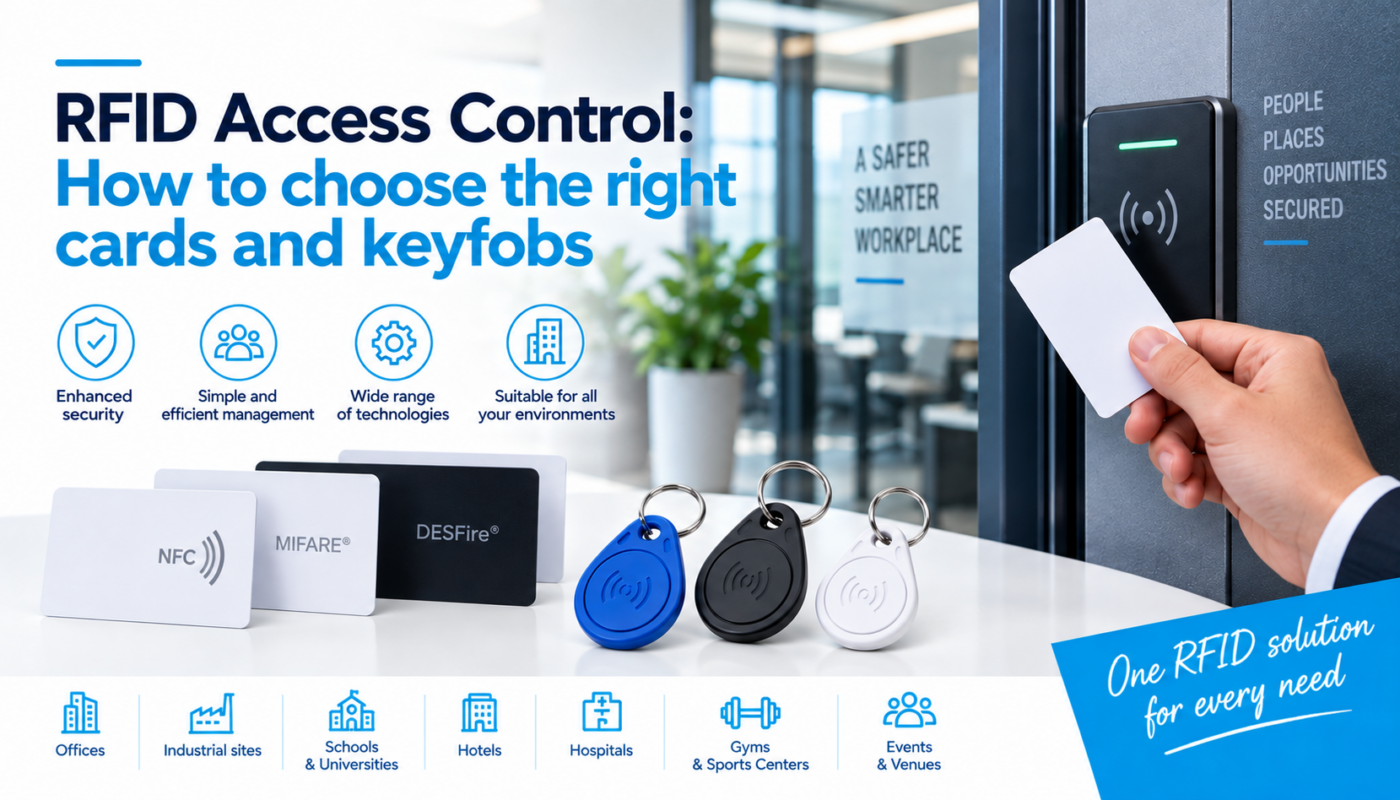
Choosing RFID credentials for a business, residential building or leisure facility involves two decisions: the technology accepted by the installation and the format users will carry. Cards, key fobs and wristbands can serve the same identification purpose when their chip is compatible with the system.
How does RFID access control work?
A reader communicates with a credential presented nearby. The access control system then applies the permissions configured by its administrator. Some installations use an identifier; others rely on application data and cryptographic authentication. Security therefore depends on the complete installation, not the shape of the credential.
Frequency alone does not establish compatibility
The EM4200 options in our catalogue use low-frequency technology, here at 125 kHz. MIFARE options operate at 13.56 MHz. A reader limited to one band does not automatically support the other.
Even chips sharing a frequency are not necessarily interchangeable. Protocols, memory, data formats and reader configuration also matter. A 13.56 MHz label does not guarantee active encryption or universal protection against copying. Ask the installer to confirm the exact technology and its implementation when cryptographic functions are required.
Choose a practical format
- White PVC RFID cards fit a badge holder or wallet. Select the chip option validated for your installation.
- ABS RFID key fobs attach to a keyring, with colours that can help organise distribution.
- Epoxy RFID key fobs provide another compact format. Confirm the conditions of use without assuming an undocumented environmental rating.
- Wristbands keep the credential on the wrist. They still need to be presented near the reader; they do not turn a proximity system into long-range access.
The housing and colour do not determine security. Compare the chip and the system’s operation before comparing physical formats.
Prepare the order and enrolment
Collect the reader reference, required chip technology, encoding constraints and enrolment procedure. When changing a reference, validate a representative credential on the actual installation before deployment.
Online orders cover standard supports. They are not automatically assigned access rights in your system. Its administrator must enrol new credentials and manage their permissions.
Before ordering, review our RFID compatibility guide. Check quantities and available options directly on the product page.

 Français